Showing posts with label cult. Show all posts

Friday, July 3, 2009

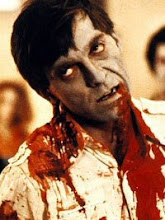
FMR: Dawn of the Dead (George A. Romero, 1978, USA)


The one thing that I've always been a fan of is movie reviews. But since I'm not a huge fan of going to see a movie nowadays (read previous blog post if you are unsure), I guess that means I must review films seen elsewhere. On Friday mornings, I will be posting a film review to correspond with the traditional opening day for many movies in the United States, but they normally won't be of whatever comes out that weekend. For the inaugural post, I chose my absolute favorite film of all time: George A. Romero's Dawn of the Dead.

Due to the success of the frightening 28 Days Later… and even the awful Dawn of the Dead remake, George A. Romero's relativity in the current horror landscape is at its most prominent since the 1970's. The creator of the modern zombie in 1968's Night of the Living Dead, Romero has made two entries in his Living Dead trilogy, 2005's Land of the Dead and 2008's Diary of the Dead, and with those successes comes renewed interest in his earlier work. Following Night of the Living Dead, Romero shot 1978's Dawn of the Dead and 1985's Day of the Dead, the latter not gaining as much praise as his first two, which seemed to take the wind out of Romero's proverbial zombie sails. The two most recent works in the Living Dead series certainly pale in comparison to his first three installments, but even a Romero not living up to his full potential is worth ten Texas Chainsaw Massacre remakes. While many continue to be entranced by his gritty debut feature, it is Dawn of the Dead that has inspired a cult following and many to suggest that it might be among the greatest films ever made. Let me add my name to that list right now: Dawn of the Dead is the greatest film ever made.

The film Romero produced on those cold nights in Monroeville, PA is not only relevant today, but also more than when it was released. The film takes place several years following Romero’s first Dead film, but one would not know it without background information on the entire trilogy. The film is designed to fit in with the series seamlessly, but without familiar characters, it can distance itself and attempt to be an entirely different film experience. At the end of Night of the Living Dead, it seemed as though the whole situation with the living dead was solved by a band of cops and rednecks. But in Dawn, Romero dives into the chaotic situation at a local television station with little disposition on the zombie holocaust occurring outside. The film starts out small, and remains that way throughout the running time. At its core, it is always about the plight and fight of the four central characters, who are simply trying to survive. Our group of survivors eventually make their escape via helicopter to a shopping mall, the film's most iconic location. There they attempt to clean house and set up a utopia where they could live for years. While the TV station may be little in comparison to the mall, the dramatic elements of the characters are always local and always intimate. The setting may grow over time, and it may increase in size, but it is always about Frannie, Peter, Roger, and Steven.

The one difference between Dawn of the Dead and other zombie films is that Romero treats his zombies fairly and does not use them as villains. The creator craftily creates the illusion throughout all three of his films that these “things” are not monsters but just a mirror image of our own society. They have families and friends, homes, children, and jobs just like all of us. The zombies in Romero films, in a way, represent the dystopia we understand but hurtle our populace at anyway. These “people” are not to be seen as alien creatures, but us without the ability to feel for another. But at the same time, they represent some of the more negative aspects of our culture, most notably the herd mentality that is fostered by excessive consumerism. They are just like us and, yes, they occasionally visit the mall.

Yes, the film is extremely bloody. Yes, there is a scene with a person's head exploding from a shotgun blast. Yes, those are real pig entrails. In complete seriousness, what truly makes this film so brilliant is not just the brutality of the image, but the complex nature of the inhumanity they paint. This isn't gore for gore's sake, but actually a tool to move the story along. To prove a point and to highlight the thematic worth of the picture. While most viewers would likely point to the physical brutality -- the arm-biting in the tenement building at the beginning of the film or the motorcycle massacre scene at the end – as the most disturbing elements of the film, it is the emotional and social viciousness that strikes the deepest. The scenes where our heroic band of outsiders fall victim to the consumer culture of the mall is by far the most devastating aspect of the film, fake intestines be damned. The four survivors devolve from their rebellious nature in the first half of the film into such a meaningless existence as they protect the mall as if it was another member of their team. The luxuries of the mall become more important to the protagonists than life itself. The true monsters in Dawn of the Dead are the living, and that is the most frightening truth of the film.

This tragic reality is just another diamond in the rough, which keeps distancing Dawn of the Dead from the mainstream and hurtling it forward into classic territory. Despite its notorious history as one of the most graphic narratives ever committed to film, it is one of the great American films of the past thirty years. The images in the film are unrelenting in gore and dismemberment, which accounts for most of its mainstream popularity, but it is also an intelligent satire on consumer culture and on horror films in general. The idea that stewed in director George A. Romero’s head grew into a monstrous exposé and, in the process, established the use of gore as a vital element in contemporary horror cinema. Romero’s understanding of human nature is quite surprising, as he is the creator of the modern zombie – a dead, lifeless, and emotionless entity.

Thursday, July 2, 2009

TAN: The Fall of the Moviehouse


For the past several years, I've aspired to be a teacher, in some capacity or another. I can find ways to flex my teaching abilities in everyday life, whether it is at work or in my home - there is always someone willing to learn and I'm game to help them. I am also a film fanatic, so when I'm not being an uncredited teacher, I also spend moments writing screenplays and teaching myself about parts of cinema that most people never experience. Recently, I've been playing around with the art of film programming, which is under-appreciated in cinephile circles. I recently got a nice Epson projector from my girlfriend as an anniversary gift (yeah, I know, I have the world's best girlfriend), so I've been sitting at my computer and combing through my DVD collection trying to build outdoor film programs for this summer. There isn't any profit from my screenings, and the crowd is never beyond friends, but the thrill of being the programmer is still there. So maybe, this is where the fusion of my love of film and my desire to teach is found.

Now, does my film programming of, say, a night of Italian cannibal movies come close to the nuanced schedule of the New Beverly? No not at all, because the brilliance of the Alamo Drafthouse and the New Beverly Cinema is not that their just semi-revival moviehouses, but because they program the shit out of their lineups for every possible facet of the film fanatic culture. Both of these establishments appeal to different segments of the moviegoing population that are not fulfilled completely with the AMCs and Marcus Theatres of the world. It's not like I can walk down to the Ridge Cinema and see a reunion of the cast of The Monster Squad, but the Alamo Drafthouse did that two years ago. I can't stroll into my local mall-based multiplex and see a double feature of Isla: She-Wolf movies, but on July 10-11, you can partake in that at the New Beverly.

I am definitely a jealous person when it comes to movies, and I am sadly geographically-deprived in the film world. In Wisconsin, specifically Milwaukee, the most revival we get is the once-a-month midnight showing of The Rocky Horror Picture Show at the Oriental Theatre. Our last bastion of uncorrupted programming was the Times Cinema, but that fell by the wayside with new ownership and the lack of an audience to watch their double features of Cary Grant. While our two "art house" cinemas show a plethora of new "indie" flicks each week, they are still part of the Landmark Theatres chain. They aren't actively programming for themselves, but instead they get sent prints because the higher-ups probably think that Away We Go will play well in Milwaukee, given the significant amount of advertising dollars thrown at it in this market. Programming at the Times Cinema changed when the new owners came in, who subsequently purchased the highly-overrated Rosebud Cinema Drafthouse. If I walked into the Times today, I would be seeing Ice Age: Dawn of the Dinosaurs. For a beautiful, almost eighty-year-old theatre, this is a tragedy, but a necessary one. I suppose I would rather see the marque lights on, no matter what is playing inside.

The greatest loss here is that of the moviehouse feel. I came of age when you lined up at a multiplex to see Star Wars or Independence Day, but even that has changed. Theatres now have reserved seating for an extra couple of bucks and food served directly to your seats, but the movies haven't gotten better. I watch a film like The Dark Knight and it doesn't give me the exhilaration that I got as a child when I first saw Jurassic Park. Staring up from our regular seating, being truly mesmerized by what was taking place on the silver screen. If I watched Jurassic Park today at the Marcus Theatres Majestic, I probably wouldn't have the same feeling pumping through my veins. Call it typical aging, but I believe it is much more than that. It was uncomfortable, inconvenient, and going to a movie was an all-night affair. Now, I can order my tickets online two days ahead of time, show up to the theatre and even have them valet my car, avoid human interaction by going to a ticket kiosk, buy a super-sized soda so I don't have to get up for a refill in the middle of Transformers 2, and arrive at my reserved seat, which happens to be perfectly in the exact middle, just as the trailers come up. If movie theatres are going under, I honestly can't wait, because I could have the exact same experience in the comfort of my own home. And that is what people do not cherish anymore - the experience of going out to a movie.

Take the Oriental Theatre in Milwaukee for example. If you live in the area, just go see a movie there once - it is unbelievable. For us in Milwaukee, we truly have a cinematic gem hidden away, and even though the programming sucks a bit more now, its great that people are going to see a movie like Star Trek in that setting, opposed to seeing it at a cookie-cutter AMC theatre. They have gone to great lengths to maintain the theatre as best they can, and it has the same appearance it had in 1927 when it opened. Ornate East Indian design and the beautiful staircase leading to the balcony - just thinking about it brings a smile to my face. This is a true-to-form movie palace, just now when you walk inside it, you have to project your own experience upon it because it just doesn't give you that feeling anymore. On the website for the Oriental, the writer describes the switch in programming from "short runs of classic and cult double features" because "video and cable TV again took away the customers." Personally, I think this is a lazy excuse and more motivated by money rather than the fact that people simply went to other mediums. There is honestly more money to be made showing a Public Enemies than there is showing a double feature of Martin and The Crazies. It really just boils down to how much money does a theatre owner need before they are happy. The New Beverly has survived for years because they haven't capitulated and continue to promote their unique format. People still go there in sell-out numbers to see movies that didn't sell-out once in their first run, so I have to ask Milwaukee theatre owners, especially the Times and Oriental, why haven't you adopted this format? Why don't you go back to your roots and see if you can rebuild what you have already destroyed?

I guess it might just be too late for Milwaukee. We have these movie palaces that are great to look at but house the same stuff I can get more comfortably at a national chain. The only thing I'm hoping for is a complete collapse of the movie theatre industry, and with the interesting business models that HDNet Movies and Steven Soderbergh are playing with, it might come sooner than you think. Once that happens, maybe these smaller art houses and regal movie palaces can go back to what they did best: reminding us of what going to a movie use to feel like, and not just being a box we sit for two hours while a director beats us into submission. Moviegoers shouldn't be subservient to the masters of the cinematic domain, but active participants in their own pleasure or pain. Think back to the last movie you watched in the theatre, and figure out how much you spent.

Don't ask if the movie was worth the money, but instead, whether the experience justified the cost.